A 19th-Century Artist Credited With Four Depictions of Emperor Norton — Each of Them Different
.Big Questions About Two of the Four
One Is Not the Emperor
GEORGE HOLBROOK BAKER (1827–1906) was born in East Medway, Mass. — now Millis, about 15 miles southwest of modern-day Boston. He was raised in nearby Dedham and Boston. Both of his parents’ families had arrived in Massachusetts from England around 1630.
After apprenticing as an engraver and starting his professional life in New York, Baker found his way to San Francisco in May 1849, a few months after his 22nd birthday.

George Holbrook Baker, c. 1860s. Tintype. California State Library. Source: Calisphere
Among his other pursuits over the next few years, Baker wrote and illustrated his observations of life in California and had these published in East Coast newspapers.
After a trip back to the East Coast, Baker returned to California in 1853 and settled in Sacramento, working for the next nine years as an artist and lithographer — initially in a couple of brief partnerships and, after 1857, independently.
In addition to briefly owning and editing two newspapers during this period, Baker produced letter sheets; a 36-page historical folio, Sacramento Illustrated (1855), with Edmund Lorenzo Barber; and a number of versions of a Bird’s-Eye View of Sacramento, a large-format (100 cm wide) sheet in which the anchor illustration was bordered with 36 vignettes of significant buildings in Sacramento.
Arguably, Baker’s illustrations of Sacramento are his most artistically and historically significant contributions.
:: :: ::
THE GREAT FLOOD OF 1862 (December 1861–January 1862) devastated Sacramento.
In the immediate wake of the flood, George Holbrook Baker moved to San Francisco and re-established himself as an artist and lithographer.
In general, Baker was successful in his profession until retiring around 1890. Although much of his San Francisco work was commercial in nature — business cards, letterheads, labels, posters, and such — he continued to produce the bird’s-eye views that initially had distinguished him.
Baker died in January 1906 from injuries suffered when he tripped off a streetcar platform and was hit by an oncoming car three months before the earthquake and fires that would consume the city three months later.
A more detailed summary of Baker’s life and art is in John E. Allen’s article “‘When I Get to California I Intend to Employ My Pencil More’: George Holbrook Baker, Argonaut Artist” (California State Library Foundation Bulletin, No. 94, 2009, p. 14).
:: :: ::
GEORGE BAKER began his longest tenure in San Francisco three years, maybe a little less, after Joshua Norton declared himself Emperor of the United States in September 1859.
One of Baker’s earliest works during this 44-year period was an 1864 engraving, Fair of the Mechanics’ Institute, 1864.
Alas, an original, scannable lithograph is elusive. Here is a photograph of a framed copy of the work that hangs at the Mechanics’ Institute, in San Francisco.

Fair of the Mechanics’ Institute, 1864 (1864), by George Holbrook Baker (1827–1906). This framed copy of an original lithograph hangs in the offices of the Mechanics’ Institute, San Francisco. Photograph: Myles Cooper
The focus of this engraving is the first pavilion of the Mechanics’ Institute, built in 1857 and located on Montgomery Street between Post and Sutter.
But, notice who shows up in the following detail of the street scene at the bottom right of the view:

That’s Emperor Norton at center right (with the walking stick) and, at center left, the Emperor’s “friend” Freddy Coombs a.k.a. George Washington II.
There are four earlier extant cartoon depictions of Emperor Norton from the 1861–63 period. But, following an October 1863 engraving by Theodore Grob that depicts the Emperor (at bottom left here) as a spectator at a public military exhibition in Oakland, this engraving by George Holbrook Baker appears to be the second earliest depiction of the Emperor in a “traditional” artwork.
:: :: ::
THE FOLLOWING YEAR, 1865, Baker — using the nom d’art “Snooks, Jr.” — featured Emperor Norton once again in his cartoon “Poor Old Bummer!!” The cartoon memorializes the death of the remaining half of the famous San Francisco canine duo of Bummer and Lazarus. Lazarus had died in 1863.

Poor Old Bummer!! (1865), by George Holcomb Baker (1827–1906), nom d’art “Snooks Jr.” As published in Albert Dressler’s 1927 book Emperor Norton: Life and Experiences of a Notable Character in San Francisco, 1849–1880. Washington University Libraries. Source: Internet Archive
Notwithstanding the exaggerated ribcage, the Emperor shown here — at front right — is a more robust and, in general, very different figure from the more slight and stooping Emperor in the 1864 engraving.
In fact, Baker’s cartoon Emperor of 1865 appears to owe much to the depiction of Emperor Norton in the following 1863 cartoon by Edward Jump:
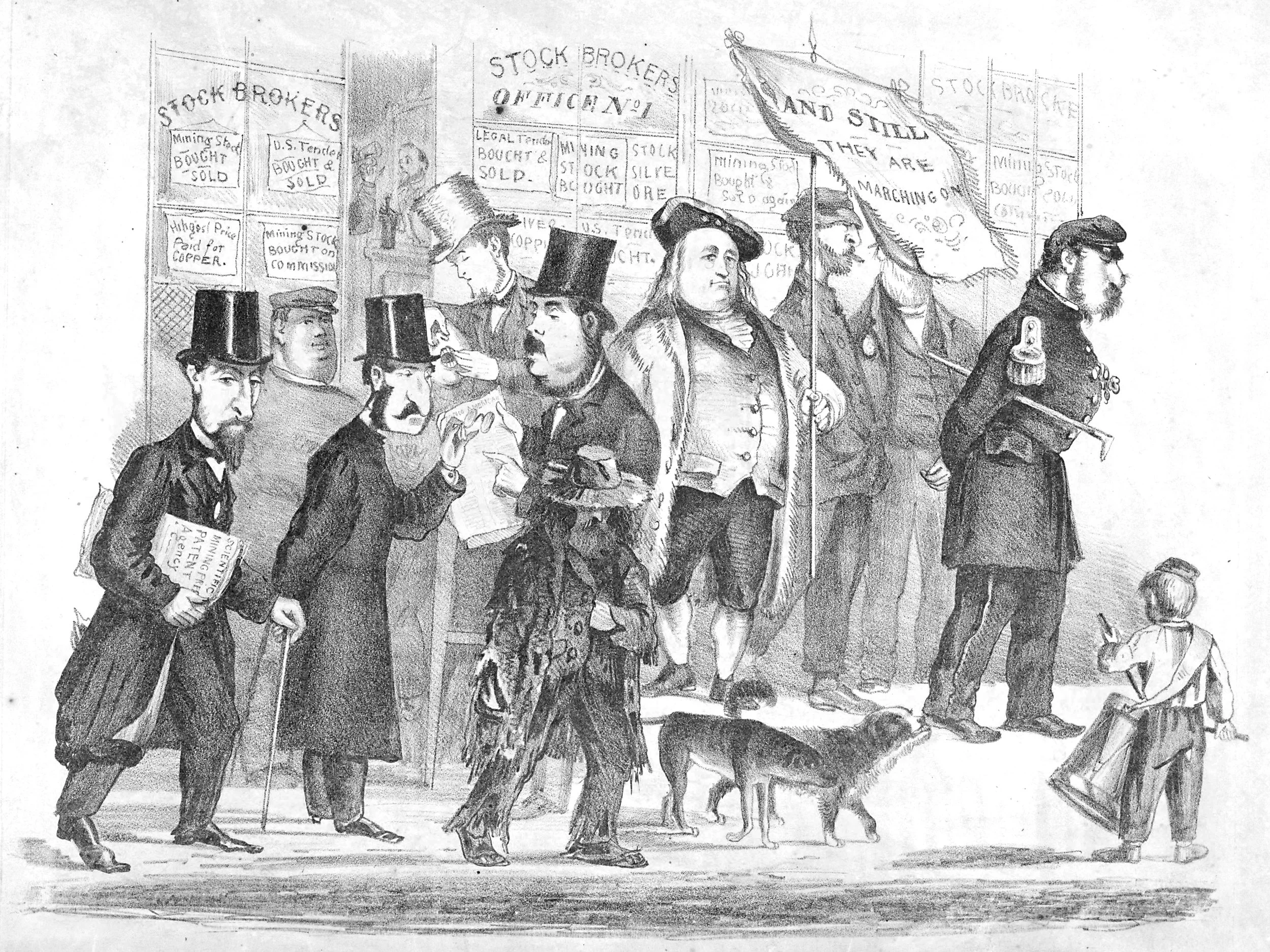
Montgomery Street scene featuring Emperor Norton; Bummer and Lazarus; and George Washington II (later titled Stock Brokers; And Still They Are Marching On), 1863 (possibly between February and September 1863), by Edward Jump (1832–1883). Collection of the Bancroft Library at UC Berkeley. Source: Calisphere
:: :: ::
THE CALIFORNIA STATE LIBRARY (CSL) has in its George Holbrook Baker Collection two more pieces — standalone sketches — that the Library identifies as being depictions of Emperor Norton.
CSL librarian Sara Cordes relates that “we have a letter/appraisal from the dealer that the collection came from which said unless otherwise noted, every sketch was done by Baker and that the two caricatures were done circa 1860.”
There may be reason to doubt the authorship of one; the identification of the other as Emperor Norton; and the dating of both.
Here’s the first of the two:

“Norton I / Emperor of Nord America / Protector of Mexico” (per inscription), probably c.1860s–70s, attributed to George Holbrook Baker (1827–1906). Pencil sketch on ruled paper, later clipped and mounted on book endpaper. Courtesy of the California History Room, California State Library, Sacramento, Calif.
Although the rendering does not really conform to the photographic record of Emperor Norton, it does manage to register as “Nortonian.” There’s little doubt that this is a drawing of the Emperor.
But, anomalies in the depiction, the mounting, and the inscription cast doubt on the dating of this drawing to c.1860 and beg questions about the authorship as well.
“Protector of Mexico”
Look closely. The sketch, originally drawn on ruled paper, appears to have been clipped and pasted to the endpaper of a book at some date after the sketch was created.
But the inscription was original to the ruled sheet. One can see that the original pencilled inscription was cut off in the process of clipping the sketch and overwritten in pen — presumably at the time of mounting. (Note how the inscription flows across the ruled paper and the endpaper.)
The inscription identifies the figure as “Norton I” and “Protector of Mexico.” Emperor Norton did issue a June 1862 Proclamation calling on Jewish, Catholic, and Protestant religious institutions to unite in designating him "Protector" — but it appears that he did not begin signing his Proclamations with the title until February 1866.
"Protector of Mexico" did not seep in to the public imagination — including for inscriptions on artwork — until after that.
This suggests — assuming that the inscription on the ruled sheet was made at the time of the sketch — that the sketch was not made until at least 1866.
Headgear
The sketch shows Emperor Norton wearing a top hat. But, photographs of the Emperor Norton do not show him wearing such a hat until c.1875 — possibly pushing the date of the sketch another decade or more later than 1866.
“Emperor of Nord America”
Given that Emperor Norton always referred to himself as “Emperor of the United States,” one has to consider the possibility that the title “Emperor of North America” that appears in this May 1875 Proclamation published in an Oakland newspaper — the only example of the phrase that we’ve found in an apparently authentic Proclamation — is evidence of an unauthorized edit:

Proclamation of Emperor Norton, Oakland Tribune, 31 May 1875, p. 3. Source: California Digital Newspaper Collection
Even leaving this aside…
Assuming that both the sketch and the inscription are by George Holbrook Baker, it seems unlikely that Baker, with his deep English ancestry from both parents — and with an English spouse, Mary Belden — naturally would have reached for a German- or Scandivanian-inflected title like “Emperor of Nord America.”
Did Baker believe that the Emperor was German or Scandinavian? Did he have other reasons for characterizing the Emperor as such?
Whichever is the case, the anomaly of the title seems sufficient to put an asterisk by the attribution of this sketch to George Holbrook Baker.
The sketch itself probably is from the 1870s or later.
:: :: ::
THE SECOND "NORTON” SKETCH in CSL’s George Holbrook Baker Collection begs a different set of questions.
Here it is:

Partially colorized pencil sketch inscribed “Norton I / Emperor of U.S. / & Protector of Mexico,” probably c.1870s–80s, attributed to George Holbrook Baker (1827–1906). Identification of the subject as Emperor Norton is challenged by possibly earlier inscriptions on the piece and by the depiction itself. Courtesy of the California History Room, California State Library, Sacramento, Calif.
The clean-shaven moonface with long burnsides and well-groomed, well-behaved, carefully combed hair. The gold-tasselled double-American-flagged shoulderpiece. The star pendant. The gold “USA” belt buckle. The forearm-length gloves. The absence of epaulettes when Emperor Norton was wearing them by March 1860, some six months after declaring himself.
Really, none of this depiction speaks to Emperor Norton.
And the “Norton I” inscription, on an oddly placed vertical, suggests a collector’s or a librarian’s wild guess added long after the sketch was created.
It seems worth noting the fainter (and thus earlier?) pencilled phrases that are visible on this artifact: (a) “Sons of America” written along the top and (b) “Officer of” across the bottom — both phrases clearly clipped off from a longer inscriptions.
The Patriotic Order Sons of America (P.O.S. of A.) is a male only — originally white and Protestant male only — “God and Country”-oriented secret society established in Philadelphia in 1847.
Today, P.O.S. of A. has only 14 surviving “camps” (chapters) in Pennsylvania. But, at its peak around 1900, the Order had about 75,000 members in some 600 camps across 20 states — with particular strengths in Pennsylvania and other Mid-Atlantic states (New Jersey, Maryland, New York).
P.O.S. of A. had a “California moment” in the late nineteenth century — but the moment appears to have been relatively brief. Historical newspaper databases suggest that the Order was not in California until 1870. The earliest San Francisco directory listing for the Order, in 1876, shows a “Washington Camp No. 1” organized in July 1874. But, this may have been a false start, as the 1879 and subsequent city directories have the camp organized in October 1877 and San Francisco newspapers do not begin regular coverage of P.O.S. of A. activities in the city until 1878. City directories indicate a peak of 7 camps in San Francisco in 1883, declining to 3 camps by 1889, the last year the directories show a P.O.S. of A. presence in the city.
By the time the Patriotic Order Sons of America got started in earnest in San Francisco, George Holbrook Baker had been in the city for 15 years. If, as we’ll continue to see, the subject of the partially colorized sketch above is a P.O.S. of A. figure — and if the attribution of the sketch to Baker is correct — then, arguably, this sketch is more accurately dated to sometime between the late 1870s and the late 1880s — not c.1860.
Like any self-respecting American “Patriotic Order,” the P.O.S. of A. talked up its support of the U.S. Constitution.
Early on, the Order was closely associated with the American Party (a.k.a. Know-Nothing Party) and shared the American Party’s nativist commitment to:
limiting “foreign influence”
restricting immigration
using public schools as a tool for pushing its xenophobic goals
And the Order was really, really into the American flag as a symbol of patriotism.
P.O.S. of A. Symbols — Gavel, Star, Tassels
Historically, the regalia for leaders of the Patriotic Order Sons of America has been an American flag-inspired “cross-belt” (sash) worn with one end over the right shoulder and the other end touching the left hip.
But, P.O.S. of A. membership certificates in 1889…

and 1891

Membership certificate for the Patriotic Order Sons of America, 1891. Source: Barry Lawrence Ruderman Antique Maps
…show that the Order’s iconography included twinned American flags in an “X” motif that could be seen as the inspiration for the American flag-inspired shoulderpiece in the sketch above.
Of further interest…
Following the collapse of the American Party, divided over slavery, by the end of the 1850s, membership in P.O.S. of A. declined sharply. But, a movement among younger members to revive the Order began in 1864, with the Order revising its original name, “Patriotic Order of the United Sons of America,” to the shorter “Patriotic Order Sons of America.”
The 1855 Constitution of the original Order stipulated for national, state, and local officers a variety of “arms and bearings” that appear to be echoed in the sketch above.
P.O.S. of A. was organized into a National Camp, General Camps (state), and Subordinate Camps (local).
From the Constitution’s article for the National Camp (p. 9):
SEC. 5 Official Arms and Regalia. — The Officers of the National Camp shall wear, when on duty or in session, the cross-belt of the Blue Degree, with their appropriate arms and bearings, which shall be as follows: The Rt. Hon. Chief shall be armed with the Gavel, as the instrument of his authority, and his peculiar bearing shall be a golden or gilt star, of five points, with a central white or colourless gem, attached to the cross-belt over the right breast, to which shall be appended two white tassels....
In the article for General Camps (p. 12), the “Arms and Regalia” section is the same, with minor variations: The officer title is “Hon. Chief” — rather than “Rt. Hon. Chief.” The cross-belt is “of the White Degree” — rather than the Blue Degree. And the five-pointed star is silver — rather than “golden or gilt.”
In the article for Subordinate Camps (p. 16), the “Arms and Regalia” section stipulates “the Gavel” for two officers: “Worthy Chief” and “Assistant Chief.” The cross-belt is “of the Red Degree.” And rosettes of different colors are substituted for the stars that officers of the National and General Camps are entitled to wear.
All of this — including the “Sons of America” and “Officer of” inscriptions — strongly suggests that the sketch above in the George Holbrook Baker Collection of the California State Library is of a particular or imaginary officer of the Patriotic Order Sons of America — and has been misidentified as Emperor Norton.
Indeed, by all accounts, the Emperor would have had no truck whatsoever with P.S.O. of A.
Was George Holbrook Baker a member of the Order — or did Baker have some other reason for drawing a sympathetic sketch of a P.S.O. of A. officer?
If so, i.e., if Baker shared the xenophobic, anti-immigrant attitudes of the Patriotic Order Sons of America, might this explain the “Emperor of Nord America” inscription on the other sketch in the CSL collection identified as Emperor Norton and attributed to Baker?
To put a finer point on it: Could the “Nord America” inscription be seen as an effort on Baker’s part to “other” Emperor Norton by depicting the Emperor as non-Anglo and thus making him appear to be even more exotic than he already was?
Interesting to ponder.
:: :: ::
For an archive of all of the Trust’s blog posts and a complete listing of search tags, please click here.
Search our blog...