EMPEROR NORTON :: Original Research & Commentary
Since late 2014, Emperor Norton Trust founder John Lumea has written and published 223 articles of original research on various aspects of the Emperor’s life and legacy. And, he has produced numerous other historical resources — an interactive map (link); an art archive (link); talks — and commentaries on these subjects.
Below are links to the most recent 30 research articles — followed by a listing of links to all the commentaries — published via the Trust’s blog.
For links to the last 100 research articles, see under “Research” in our general blog archive.
A complete listing of all 239 (current total) research articles and research-related news items is here.
Permissions and attribution
Unless otherwise noted, all research published in articles via The Emperor Norton Trust’s blog was conducted and written by John Lumea for The Emperor Norton Trust. Creators in any medium who wish to quote, adapt or otherwise use this research in any published work that draws on this research must secure permission from the Trust and provide appropriate attribution in the work. For further information, please contact us.
SEARCH OUR BLOG…
ORIGINAL RESEARCH
In 1852, Joshua Norton bought a well-situated piece of San Francisco property that remained vacant for more than two decades — but that, a year after his death, became the landmark site that it remains 145 years later.
Joshua owned the property for only a few months. But, the timing of the purchase; the auctioneer; the future owners; the proximity to his funeral site; and the monumental buildings that rose here may imbue the land with more significance than any other acreage that Joshua purchased at the height of his prosperity.

A certain conventional wisdom characterizes — and caricatures — Emperor Norton as an imperious, high-handed blusterer with something of a dictator complex.
But a countervailing body of evidence shows that, on matters that the Emperor saw as being of greatest consequence, his impulse often was not to try to rule by fiat — but rather to call on recognized leaders to gather at specified location a few months hence; organize themselves as a council; and chart the most productive specific path forward within the general parameters that he had set.
Or, on occasion, the Emperor cast himself in a supporting role by offering himself as a neutral diplomat to broker a peace between disputing parties.
Presented here are four examples showing how Emperor Norton’s insistence on a well-ordered and just society arose from the instincts of a thoughtful reformer seeking to bring together leaders for the purpose of influencing and leveraging their collective agendas and actions — and that he was not the cartoon autocrat of “weird history” podcasts and drive-by social media reels.

Certain themes come up again and again in the Proclamations of Emperor Norton. The Emperor’s demand for revised or completely new national and California state Constitutions, for example. Or his insistence on being provided with accommodations or clothing better suited to his status as Emperor.
Most often, when the Emperor returns to an earlier theme, he simply issues a fresh iteration of the imperative that reads as though he is stating it for the first time.
Sometimes, though, he makes a point of referencing his original Proclamation on the subject, as if to say: “I shouldn’t have to repeat myself, but your inaction on the matter leaves me with no other choice.”
In at least one documented case, the Emperor issued a Proclamation on a matter more than a decade after he initially stated his policy on it.
This latter practice suggests that Emperor Norton had a good memory. It also raises interesting questions about what kind of records the Emperor might have kept about his Proclamations and their publication history.
Presented here are three examples, together with a few concluding thoughts on the question of imperial record keeping.

In mid August 1869, the transcontinental railroad had been completed for three months. The first passengers would not arrive in Oakland for another three weeks. But, with Oakland slated as the terminus, San Francisco was understandably nervous about the prospect of being cut off from the new railroad by a wide and bridgeless bay.
Seeking to exploit these anxieties, the Oakland Daily News published a satirical piece — in the form of a Proclamation of Emperor Norton, complete with a “Norton I” signature, but clearly a hoax and a prank — that had the Emperor calling for an absurd “bridge to nowhere” that not only bypassed San Francisco altogether but that pursued a meandering path “from…Oakland Point, from thence to the mountain range of Saucilleto and from thence to the Farallones” — a rocky outcropping of mostly uninhabitable islands and stacks 28 miles to the east of San Francisco’s Pacific coast.
This fake decree is the best-known example of a newspaper using “the Farallones” as a rhetorical device to skewer and scale down the empire of Norton I.
But it’s not the only example.
From 1864 or 1865 until his death in 1880, Emperor Norton is documented to have been a resident of the Eureka Lodgings, at 624 Commercial Street between Montgomery and Kearny, in San Francisco.
The two book-length biographies of Emperor Norton fleshed out those bones with the names of the landlords…
In 1939, Allen Stanley Lane noted that the Emperor's landlord at the Eureka was David Hutchinson.
In 1986, William Drury added the detail that Hutchinson was preceded at the Eureka by Aaron Babcock, who probably was the landlord who took on the Emperor at the Eureka. (Drury mistranscribed Babcock's first name as "Alfred.")
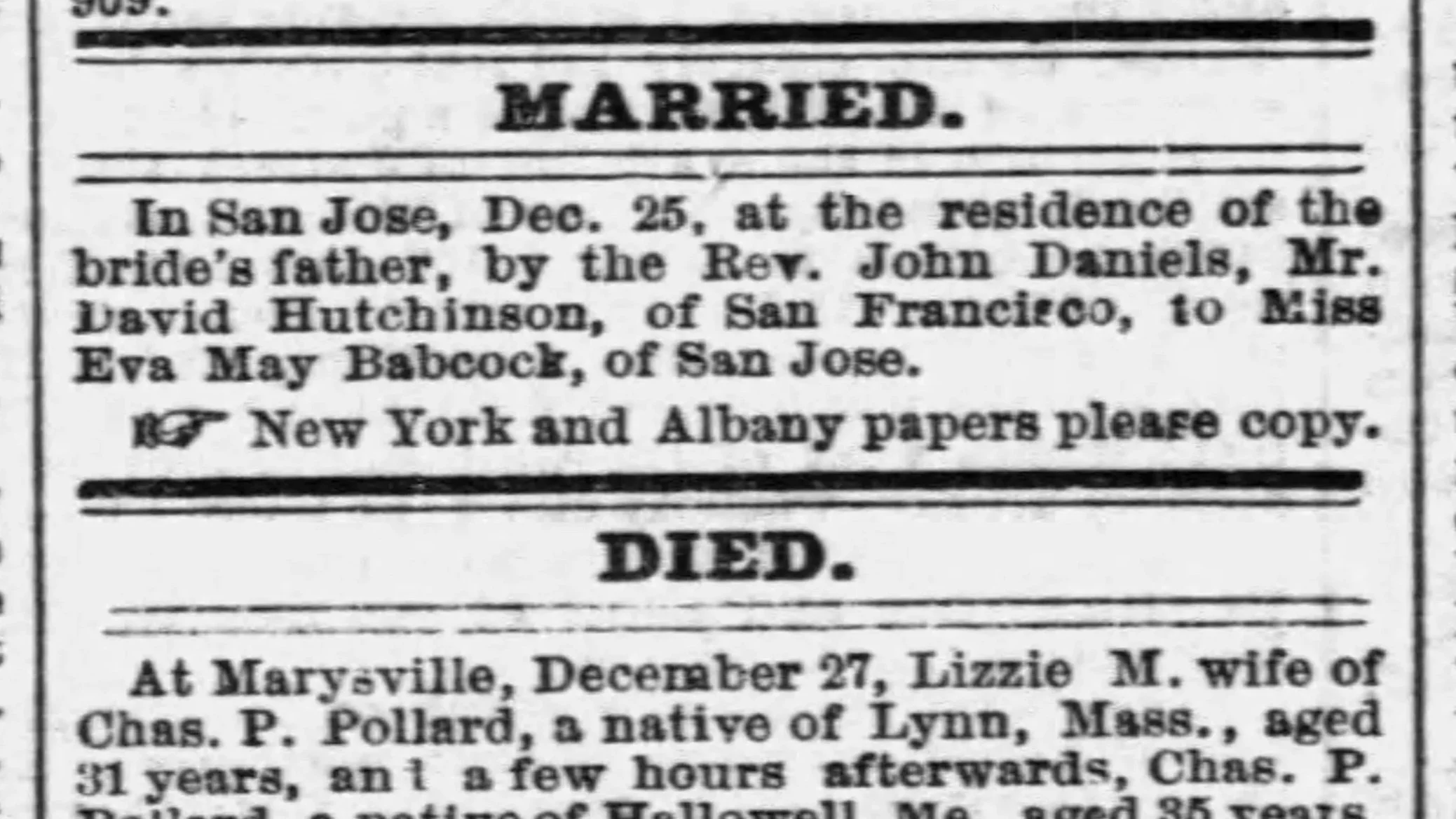
Our latest discovery — a part of the Emperor’s story that we believe is documented here for the first time — reveals that David Hutchinson and Aaron Babcock had much more in common than a famous tenant whose residency at the Eureka Lodgings stretched across both of their proprietorships.
The connection is to do with a marriage that probably was a significant — perhaps the most significant — reason why Emperor Norton's living arrangements at the Eureka were so amenable and so secure for so many years.
Read on to learn who was the groom and who was the bride.
Documentation included — as always.

Between September 1870 and May 1875, the Black-owned, San Francisco-based Pacific Appeal newspaper published some 250 Proclamations from Emperor Norton — by far, more than any other publication.
In an unsigned Proclamation published in the Appeal on 8 May 1875, the Emperor warned unsuspecting immigrants against purchasing lots in what he saw as a fraudulent real estate scheme by Charles R. Peters to build a new town called “Newark” on swampy land along the eastern edge of the narrow southern tip of San Francisco Bay.
After the exceptionally thin-skinned and litigious Charles Peters responded by suing the Appeal’s editor, the editor — Peter Anderson — published a retraction of the Proclamation in which he forbade Emperor Norton from bringing the Appeal any more Proclamations.
A Proclamation of Emperor Norton never again appeared in the Pacific Appeal during the Emperor’s lifetime.
The received wisdom has been that the unsigned Proclamation that ran in the Appeal on 8 May 1875 was the Emperor’s opening salvo against Charles Peters.
In fact, as we recently discovered — and as we believe is documented here for the first time — a shorter signed Proclamation on the same subject had appeared five days earlier — on 3 May 1875 — in the Oakland Tribune.
The differences in how the Tribune and the Appeal dealt with Charles Peters and Emperor Norton — and in how Peters dealt with the respective papers — is its own fascinating and very telling story.
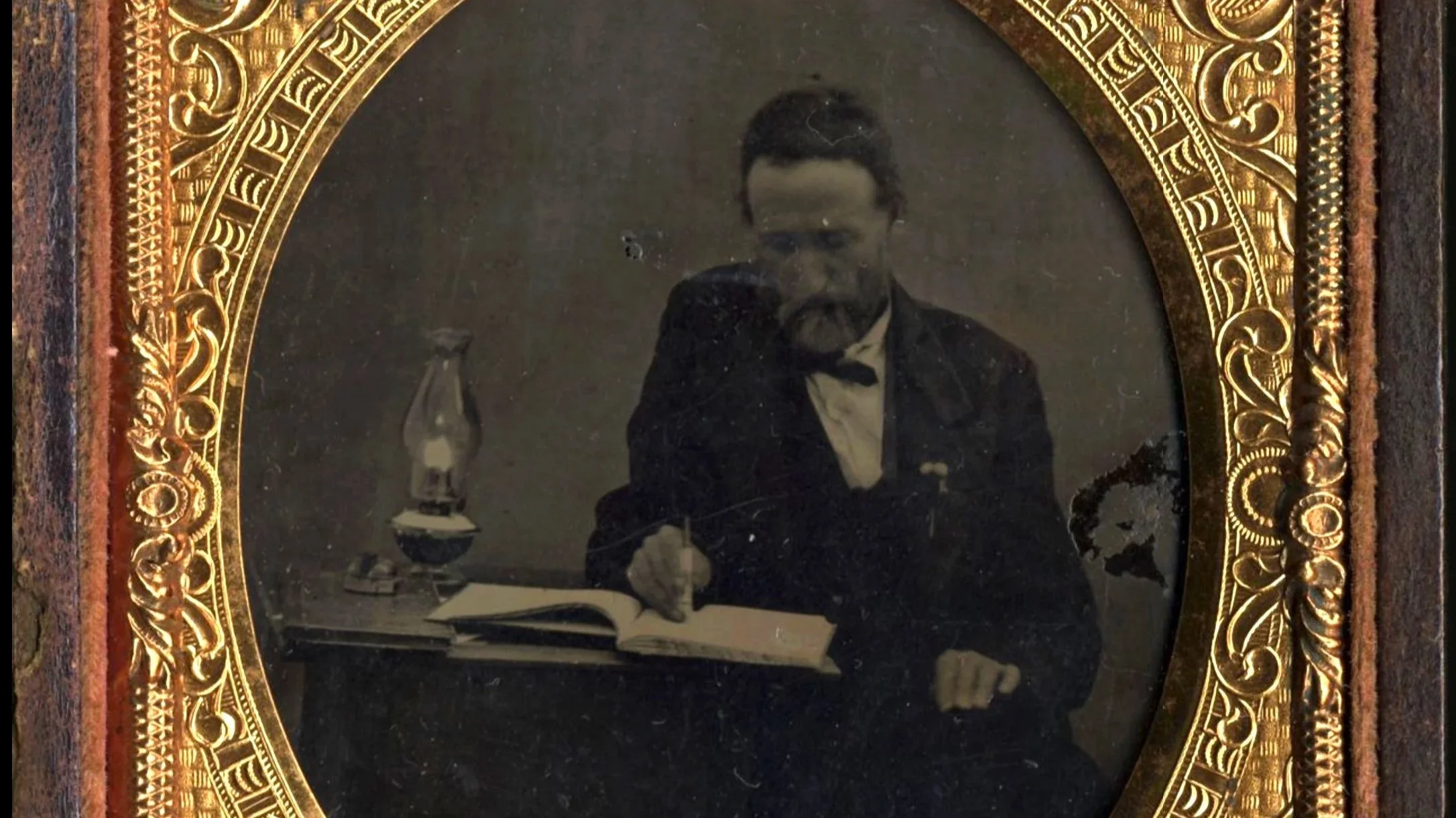
Cartoonists George Frederick Keller (of the San Francisco Wasp) and Edward Jump are well-known as artists who — during Emperor Norton's lifetime — often featured the Emperor in their works.
Much less well-known — indeed, not known at all by most — California pioneer artist and lithographer George Holbrook Baker (1827–1906) is credited with four depictions of Emperor Norton: (a) two in multiple-figure engravings published in 1864 and 1865 and (b) two unpublished sketches of the Emperor dated to c.1860.
The subject matter, dates, and attributions of the published works are not in question.
But, in this new analysis, we raise serious questions about the unpublished works, including: the characterization of the Emperor in these works, the dates, the artistic attributions, and — in one case — the subject matter itself.
If you've never heard of a white male anti-Catholic anti-immigrant secret society, the Patriotic Order Sons of America, that was established in Philadelphia in 1847 and briefly active in California in the 1870s and '80s, count this as one more reason to pull up a chair.
Includes images of very rarely seen works.
By February 1856, Joshua Norton was moving away from the Democratic Party, disgusted by corruption in the local party apparatus.
In August 1858, Joshua announced his intention to run as an “independent candidate” for U.S. Congress.
In one of his earliest Proclamations as Emperor, he lamented in October 1859 “that open violation of the laws are constantly occurring, caused by mobs, parties, factions and undue influence of political sects.”
Later, in 1869 and 1876, Emperor Norton issued Proclamations dissolving and abolishing the Democratic and Republican parties.
And in July 1875, he gave an impromptu speech at a “No Party” forum held at the Mercantile Library.
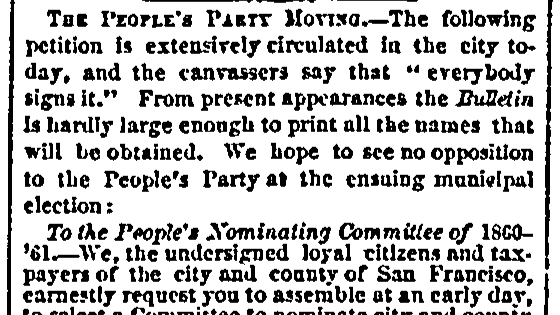
Comes a new discovery: In April 1862, Emperor Norton signed a petition calling on the “anti-party” People’s Party to begin the process of nominating candidates for the local San Francisco offices in the upcoming election.
This may be the earliest documented record of Emperor Norton — as Emperor — formally aligning himself with a specific independent approach to politics.
It may also signal a pivot towards a greater engagement with local and state issues after an initial period, 1859–62, in which the Emperor seemed more interested in national and international affairs.
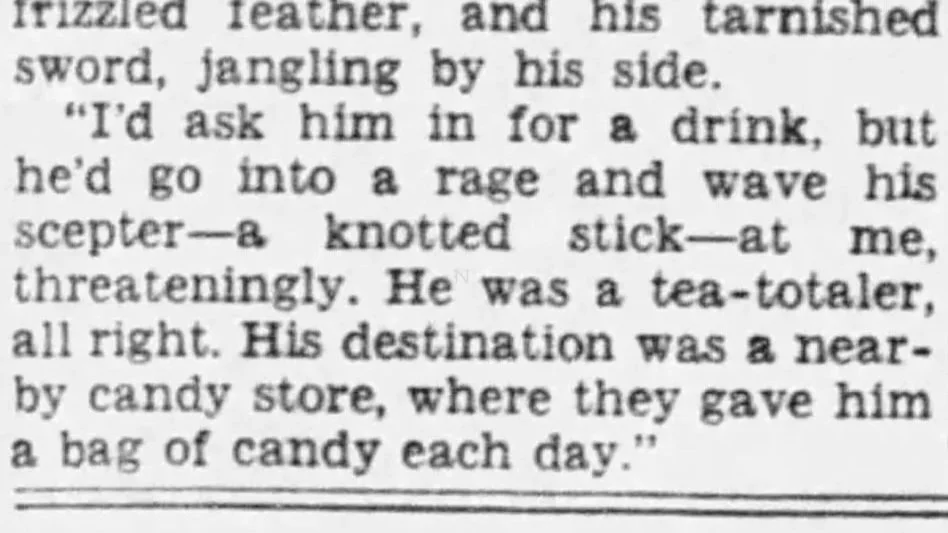
In 1936, the San Francisco News ran a profile of 75-year-old "pioneer bartender" Jimmy Giusto in which Giusto claimed that Emperor Norton preferred a bag of candy to a drink.
This prompted a letter from a George Murphy calling out Giusto for exaggerating his pioneer bona fides. Murphy claimed to be "a gentleman who drank with 'Emperor' Norton" and went on to assert that the Emperor could not have frequented candy stores, as that would have made the Emperor a "sissy."
We disagree with Murphy on the last point, as there is a practical reason why Emperor Norton could have had a fondness for candy.
But, the whole episode illustrates how slippery memory can be.
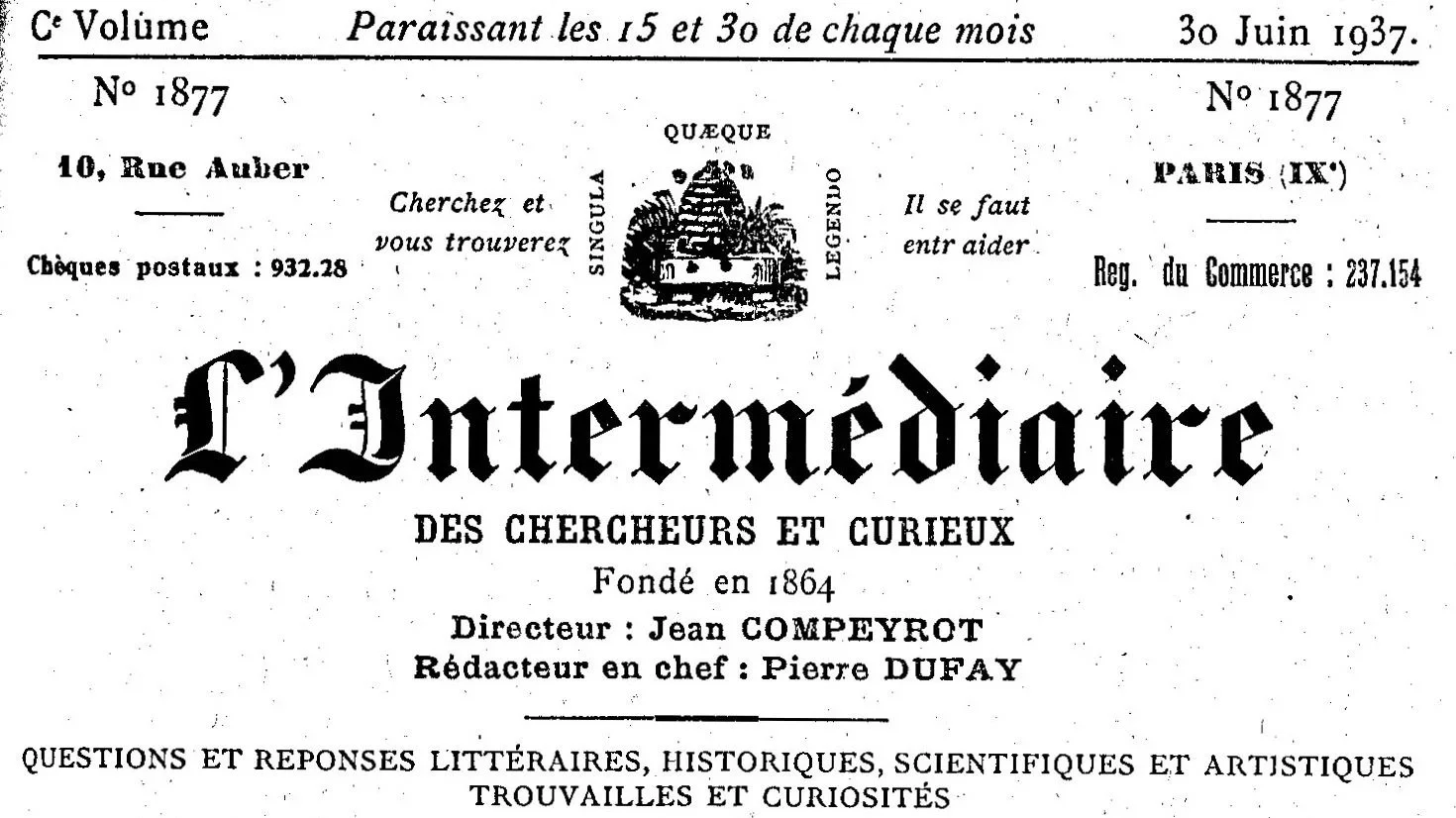
In 1937, French and English contributors to two scholarly journals — published in Paris and London, respectively — tuned in to Emperor Norton, most of them for the first time apparently.
It’s hard to know what to think of the “evidence” they included — and how they treated it.

Between July 1865 and November 1867, Western Union ventured a project to lay telegraph cable under the Bering Strait that would connect Russian America (R.A.) — which became the U.S. territory of Alaska in October 1867 — with North East Siberia (N.E.S.).
A cultural by-product of this effort was The Esquimaux — a monthly journal/newspaper published in Port Clarence, R.A. (10 issues), and Plover Bay, N.E.S. (2 issues), between October 1866 and September 1867. The Esquimaux generally is credited as being the first newspaper published in Alaska.
The Western Union staffer who was The Esquimaux’s editor and proprietor had spent the previous five years (1860–65) working in various capacities at the San Francisco Daily Morning Call — which in early 1863 located to the 600 block of Commercial Street, where Emperor Norton took up residence sometime between summer 1864 and summer 1865.
Perhaps this made it inevitable that the Emperor would find his way into the pages of this little “tabloid of the tundra.”
Still. It’s a fascinating story.

Surely no single artistic depiction of Emperor Norton has been reproduced more times, over a longer period, than the cameo “cut” of the Emperor that featured on the fronts of his various scrip between January 1871 and January 1880.
Although inked copies of the depiction appeared on some 3,000 of the Emperor's promissory notes over the course of 9 years, precious little can be said for certain about the original engraving — including who carved it.
In this exploration, we dig into various particulars of the two note printers of record — Cuddy & Hughes and Charles A. Murdock & Co. — and connect some dots that point to likely scenarios for (a) why and when the engraving was created; (b) what the model for the engraving was; and (c) how it was "stewarded" for 9 years.
Included here: A rarely seen — and very large — image of the earliest-extant Norton note from November 1870, including the Emperor's mostly-intact red wax seal.
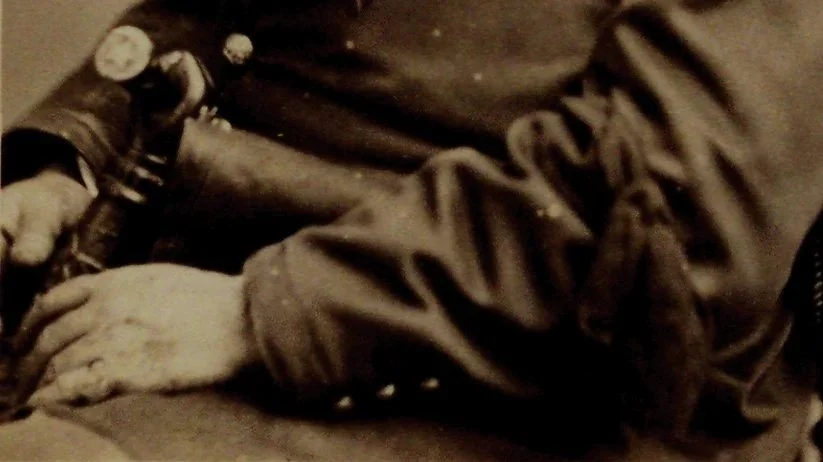
In Victorian-era Britain and the United States, the mourning of a loved one or public figure was guided by an elaborate set of rituals and customs.
Among these: A man in mourning wore a black armband on his upper left arm. This could be a properly sewn and hemmed item — whether “homemade” or professionally manufactured — or, more simply, a hand-tied strip of black crape.
Often on this date — the anniversary of Emperor Norton’s death on 8 January 1880 — we at The Emperor Norton Trust have highlighted a particular late-1870s photograph of the Emperor, in profile, as the photo carries a certain funereal aspect.
Innumerable times over the last 12½ years, we have looked at this and another photograph of Emperor Norton from the same sitting without noticing that the Emperor is wearing a black mourning band in both photos.
As we don’t find this photographic detail documented anywhere, it stands to reason that no one else has noticed it either.
A little digging reveals who, most likely, the Emperor was mourning.
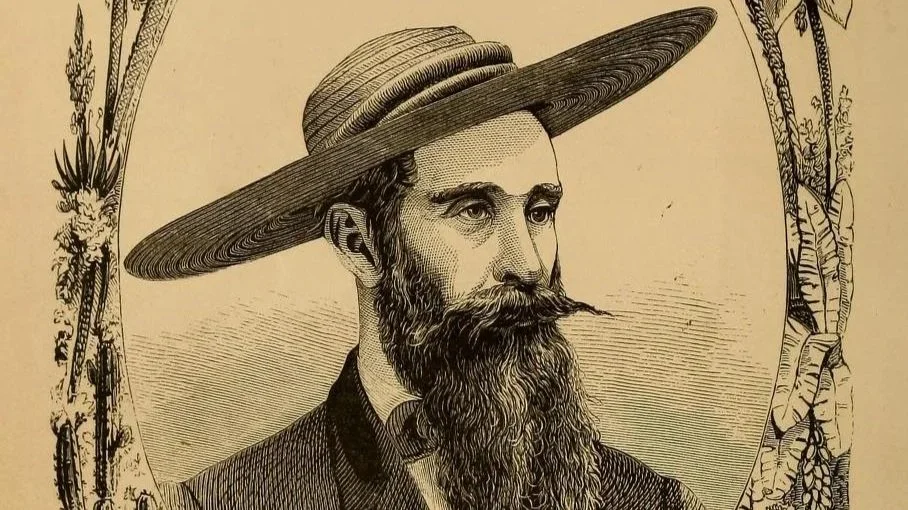
Probably the most notorious contemporaneous fabricator of fake proclamations and fake tales of Emperor Norton was Albert S. Evans — editor of the Daily Alta California newspaper from 1863 until his death in 1872.
We've unearthed a previously unreported little cache of Evans's Norton tales which never appeared in the Alta — but which did appear in Evans's late 1870 Mexico travel memoir Our Sister Republic.
By way of hedging bets on the reliability of the book's content, the Alta's own review of the book noted that "[t]he author has a lively sense of the grotesque and humorous, which finds ample opportunity for gratification wherever he goes."
One question that hovers over our discovery...
Did Emperor Norton see Evans's misrepresentation of him in this book — and, if so, did this play a role in the Emperor's decision, a couple of months later, to designate a different paper, the Pacific Appeal, as the official platform for his public communications?

In early 1850, Joshua Norton was brought before San Francisco Alcalde John W. Geary on charge of assault — and was found guilty and fined.
That’s how a “Pioneer” eyewitness remembered it in 1887, in the pages of The Overland Monthly.
Corroborating — preferably contemporaneous — evidence would be needed in order to give this story full credence. But, IF the story is true, it could be seen as providing an early anchor and baseline for later documented reports that Emperor Norton could be prone to having a short fuse, if he felt he was being disrespected.

It long has appeared that Emperor Norton’s reputation for supporting women’s right to vote rests entirely on his having signed an October 1878 petition advocating for the right.
Comes our new discovery that the Emperor attended a women's suffrage convention in San Francisco seven years earlier — in May 1871.
Emperor Norton's apparent early interest and engagement on suffrage raises the question: Why has there yet to surface a Proclamation in which the Emperor offers his take on women’s right to vote?
Included here — in addition to the discovery from 1871 — are new details about the 1878 petition and what we believe is the first publication of (a) images of this petition, including Emperor Norton's signature, and (b) a link to the petition that identifies the Emperor's connection to it.

Among close observers of the Emperor Norton story, Eadweard Muybridge's early 1869 photograph of the Emperor astride a velocipede is a fond and well-known piece of the visual record.
New evidence reveals who was acting as the “sole agent” — i.e., seller and publicist — for Muybridge’s work at the time he took this photograph — and points to a slightly earlier date for the photo than The Emperor Norton Trust previously has believed and used in its published research.

Researchers of early San Francisco are well served by historical newspaper clearinghouses like Newspapers.com, Genealogy Bank, and the California Digital Newspaper Collection (CDNC).
Between these three databases, historians can find nearly-complete collections of the earliest mid-to-late-19th-century decades of the Daily Alta California, Daily Evening Bulletin, San Francisco Chronicle, San Francisco Examiner, and others — in the case of the Alta, dating back to 1849.
A notable outlier has been the Morning Call.
Founded as the Daily Morning Call in December 1856 and simplifying a bit to The Morning Call in December 1878, the Call has been available online at Newspapers.com and CDNC — starting with the edition of 1 April 1890.
But the only way to access earlier editions of the Call has been via microfiche or the original deadwood.
The culmination of a digitization project that was jump-started by The Emperor Norton Trust a year ago — in September 2024 — the following 26 years’ worth of the early Call arrived on Newspapers.com last month:
Daily Morning Call — 8 December 1863 – 20 December 1878
The Morning Call — 21 December 1878 – 31 December 1889
This
closes a significant longstanding documentary gap in the online historical newspaper record;
opens up a new avenue of research into the life of Emperor Norton — and early San Francisco history more broadly; and — a notable bonus…
creates new access to the editions of the Daily Morning Call that carried Mark Twain’s writing between June and October 1864.

In general. the question of how Emperor Norton raised money to help support himself is answered with reference to two imaginary-yet-real projects of world making:
collecting from specific friends and former business associates “taxes” due the Imperial Government of Norton I
“selling” to the general public promissory notes backed by said Government
Rarely if ever mentioned is the possibility that the Emperor also, at times, was reduced to garden-variety street panhandling.
But there is at least some anecdotal evidence to suggest that he was.

On 21 August 1854, Joshua Norton was inducted as a member of Occidental Lodge No. 22 of Free and Accepted Masons.
A little less than four years later, on 15 June 1858, Joshua was "suspended for non-payment of dues" from Occidental 22.
In 1975, Occidental 22 merged in with the San Francisco-based California Lodge No. 1 of F. & A.M. — the oldest Masonic lodge in California — after which Occidental 22 ceased to exist as a separate lodge.
In June 2024, The Emperor Norton Trust suggested to California 1 that it explore the possibility of posthumously reinstating Joshua Norton and forgiving his unpaid dues.
A year later, on 3 June 2025, California 1 did just that.
Of course, there were a few more twists and turns.
This is the story of a homecoming.

For nearly a century, the collection of the Society of California Pioneers has included a photograph whose subject has been identified — including by the authors of the two published biographies of Emperor Norton and by The Emperor Norton Trust — as Joshua Abraham Norton.
There are many good reasons for believing that the gentleman in the photo is not, in fact, Joshua Norton — and no good reasons, it seems, for continuing to believe that it is.
Herewith, a reassessment.

More than a decade ago, in February 2015, The Emperor Norton Trust issued its first research on Emperor Norton's birth date. In a talk that we published online the same month, I argued for a birth date of 4 February 1818.
In that talk, I outlined the role of the Emperor Norton Memorial Association in securing a new burial plot and headstone for the Emperor in 1934 — after his remains were exhumed from San Francisco’s Masonic Cemetery as part of the city’s great “cemetery eviction” of that period — and I laid at the feet of Robert Ernest Cowan (1862–1942) much of the blame for the incorrect "1819" birth date that the Association inscribed on the headstone that they placed at the Emperor’s new grave in Woodlawn Memorial Park, Colma, Calif.
In 1923, Cowan had published an essay on Emperor Norton in the new California Historical Society (CHS) Quarterly — of which he was the inaugural editor. In the essay, Cowan faked an 1819 birth date for the Emperor by falsifying an 1865 item in the Daily Alta newspaper.
Apparently no one caught this at the time — and probably wouldn’t have said anything if they had. Indeed, in 1934 Cowan remained deeply influential and respected in California history circles. His account of Emperor Norton still was regarded as a reference standard. And there had been no challenge to Cowan’s 1923 claim of an 1819 birth date for the Emperor. So, the Association just went with their friend Cowan — regarding the question of the Emperor’s birth date as having been settled years earlier.
We thought it was no more complicated than that.
Comes new evidence — which we publish here on the 91st anniversary of the dedication of Emperor Norton's 1934 headstone:
Cowan revived and even ramped up his decade-old birth date fakery in early 1934, and did so while he was president of the board of the California Historical Society — a board that included 2 of the 4 officers of the new Emperor Norton Memorial Association — one of whom was the Association’s president.
It seems that — more than we knew: In 1934, the fix was in for a falsified 1819 birth date on the Emperor's headstone.

In 1968, Crowley Maritime built a new 500-passenger sightseeing vessel for its Red & White fleet based at Fisherman’s Wharf.
Having decided to name its new vessel the Harbor Emperor, Crowley commissioned Elwin Millerick, a folk sculptor in Santa Rosa, Calif., to hand-carve a 5-foot-tall wooden figurehead of Emperor Norton for the bow.
The Emperor Norton figurehead has been photographed thousands of times over the decades and has become a fond feature of the modern Norton pop culture of San Francisco.
Pull up a chair for my theory that — at a minimum — the head and the hat of today’s Harbor Emperor figurehead are not original to 1968 and that — whether because of an accident, vandalism, or rot — they were substantially modified or switched out entirely sometime in the 1970s.

This follow-up to my August 2015 article, “The Houseworth Photographs,” updates the record of photographs of Emperor Norton by the studio of Thomas Houseworth & Co. with (a) a much better — if still flawed — copy of a c.1874 photograph and (b) a sharper date for a later Houseworth photo of the Emp.

In summer 2016, The Emperor Norton Trust launched its digital ARchive of Emperor Norton in the Arts (ARENA) with 40-some images — including an intriguing illustration featuring Emperor Norton that appeared to be an early engraving created during the Emperor's lifetime.
The illustration appears in the 1964 book The Forgotten Characters of San Francisco. But, apart from a credit to Robert Grannis Cowan — the son of Robert Ernest Cowan (1862–1942), whose title essay anchors the book, and also apparently (the younger Cowan) the private owner of the illustration who gave permission for it to be reproduced — the book provides no details about the artist, original source, or provenance of the illustration.
For the last nine years, this has been the extent of our knowledge about this work.
A few weeks ago, seeking intelligence about an elusive cabinet card of Emperor Norton, I requested from the Society of California Pioneers some catalog information about the Emperor-related items in the organization’s collection.
Included in the information the Society sent to me was an unbidden clue about the enigmatic illustration — a clue that has enabled me to solve the mystery and, in the process, crack a window into the the elusive history of one of San Francisco’s most influential early engravers and one of the city’s earliest satirical magazines.

In 1879, an 18-year-old Charles Andrew Gunnison (1861–1897) took a trek across the United States from his home in San Francisco, visiting several cities on the Eastern seaboard and venturing up to Montreal and Quebec City before returning to San Francisco via Panama and Central America.
Gunnison brought with him an autograph book that he converted into a sketchbook to help him record what he saw.
One of the last sketches in the book — done as Gunnison arrived back home at the end of his trip — is of Emperor Norton.
Apparently drawn in December 1879, a month before the Emperor’s death in January 1880, this is one of the last (and possibly the last) extant artistic rendering of Emperor Norton — painting, sketch, or otherwise — done during the Emperor’s lifetime.
A separate sketch on the same page and another sketch on the previous page provide clues that reflect the anti-Chinese mood of San Francisco —and possibly also of the artist — in 1879. Given the Emperor's own long-standing defense of the Chinese, the juxtaposed sketches make for a telling — if unintended — commentary.
Charles Gunnison died only 18 years later. One hopes that, if — in 1879 — a late-teen Gunnison did share in the prevailing anti–Chinese attitudes of 1879 San Francisco, he was able to wrest free of those attitudes before the city did.

On the verge of leaving office in March 1797, George Washington in September 1796 issued a Farewell Address — initially published in a Philadelphia paper and thereafter widely distributed. Washington's overriding concern in the address was the danger of factions and what he called "the spirit of party."
Sixty-four years later, in February 1860 — in the nearest thing to an "inaugural" address for his nascent Empire — Emperor Norton sounded the same themes.
Indeed, by 1856, Joshua Norton was showing the interest and inclination towards "independent" and "No Party" platforms and candidates that would shape his reign as Emperor.
But, there are other parallels between Norton and Washington — the date each chose to issue a defining statement for publication; their use of the same key words and phrases — that make it worth asking whether the Emperor's apparent echo of Washington is more than a coincidence.

Obituaries for Emperor Norton noted that his room at the Eureka Lodgings, 624 Commercial Street, was about 5 or 6 feet wide and 9 or 10 feet long.
It can be difficult to get a sense of how small, in practical terms, such a tiny space would be — and, for some, still is — to live within. In a room of this size, adding even the sparest amount of furniture potentially increases the claustrophobic impact, (a) by making the space register visually as even smaller than it already is and (b) by exponentially reducing the square footage available for moving one’s body around.
A 2022 photograph taken inside a rentable room of the SRO that replaced the Eureka building in 1910 gets us closer to an understanding of what this must have felt like for the imaginary Emperor and for the very human Joshua Norton.

In fall 1932 — in connection with San Francisco's mandated "eviction" of cemeteries within the city limits — the remains of Emperor Norton were exhumed from their original resting place in the city’s Masonic Cemetery.
In 1934, the Emperor was reburied, with a new headstone, at his current resting place: Woodlawn Memorial Park, in Colma, Calif.
A public ceremony dedicating the new gravesite was held at Woodlawn on 30 June 1934. This is the date that received headlines around the country — and it is the date that those who follow the Emperor's story associate with his reburial.
But the reburial itself took place nearly 3 months earlier, on 2 April 1934 — 91 years ago today.
Click below to learn more — and for our suggestion about how to provide for more thoughtful and intentional preservation and care of Emperor Norton's headstone and gravesite.

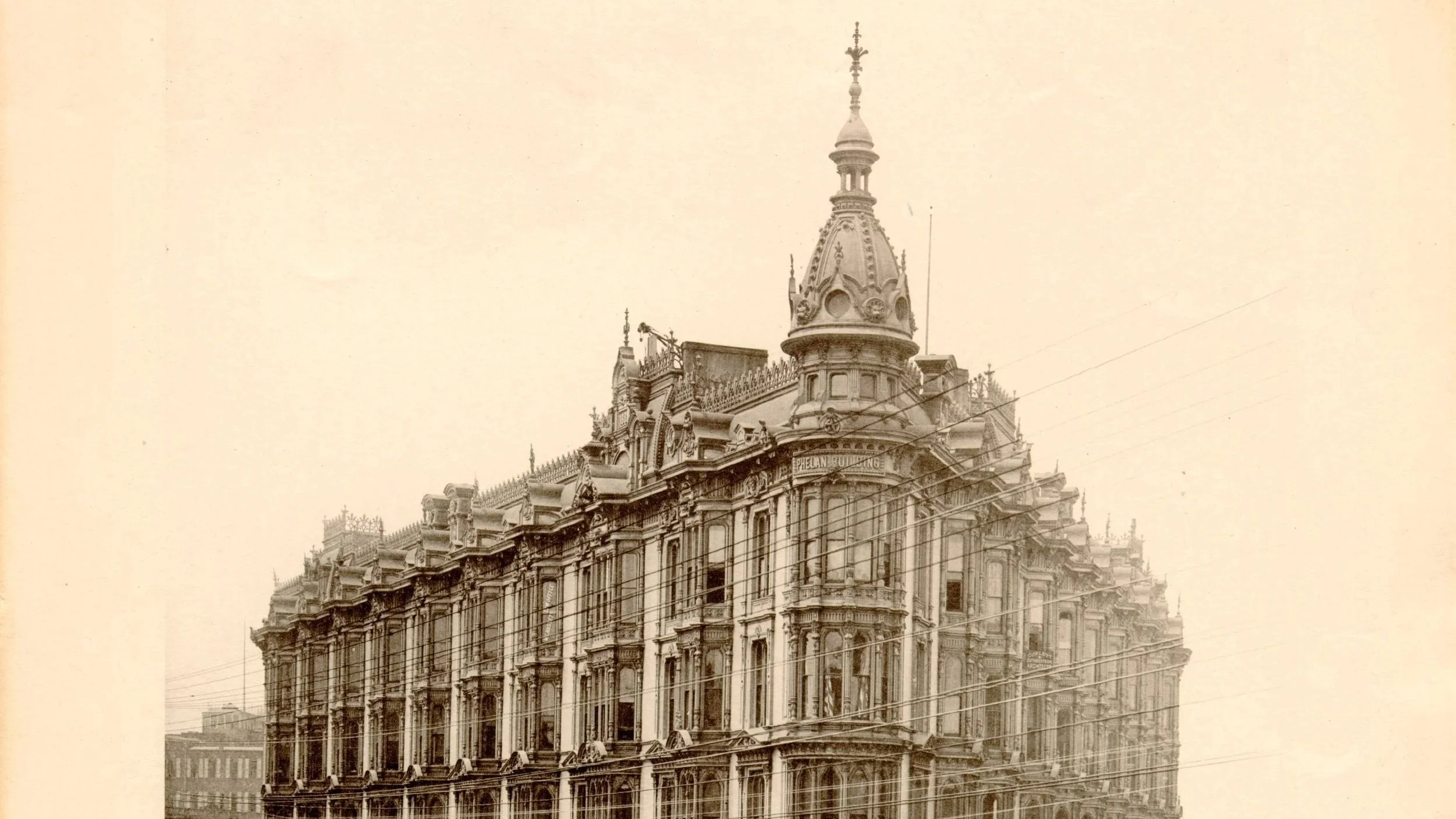
As we've noted many times, Emperor Norton lived in the Eureka Lodgings ― located in a building at 624 Commercial Street between Montgomery and Kearny Streets — from 1864–65 until his death in January 1880.
Recently, a correspondent alerted us to something we'd never seen: a bird's-eye photograph showing the 600 block of Commercial in the immediate aftermath of the earthquake and fires of April 1906.
We knew that the Eureka building had been lost in the event — but we'd never seen photo-documentation of the loss and believe this is the first time this already-rarely-seen photo is being shared in this context.
This photograph sharpens the focus on the identities and locations of the buildings along this stretch of the 600 block of Commercial — and exactly what each building suffered in 1906.
This includes three buildings that the photos shows as being leveled by the event:
624–628 Commercial
Housed the Eureka Lodgings at 624 from 1864 to 1880. Currently the site of a 4-story mixed-use apartment building at 650–654 Commercial.620–622 Commercial
William Meakin's model-making workshop. Currently the site of Empire Park.612 Commercial
Offices of Jewish newspaper The Hebrew. Previously, 1863–71, offices of The Morning Call — the period when Samuel Clemens, the future Mark Twain, was living in San Francisco and working at the Call in the summer of 1864. Also: Bret Harte had a desk here in the 1860s, while he was working as secretary to the administrator of the original branch Mint, next door. Rebuilt by 1912; demolished by 1984.
Read on for our deep-dive — including our highly researched new infographic, based on the post-quake photograph, that can be used as a tool for understanding the history of this location.
RESEARCH SPONSOR
The research enterprise of The Emperor Norton Trust initially was made possible, in part, by a seed grant in the form of a 2015 Research Gift from the San Francisco History Association.
COMMENTARY

Undocumented myths, legends, and apocryphal tales about Emperor Norton are not part of the Emperor’s biography.
But, if used responsibly, these extra-biographical resources can play a role in broader cultural portrayals of the Emperor.
On the verge of leaving office in March 1797, George Washington in September 1796 issued a Farewell Address — initially published in a Philadelphia paper and thereafter widely distributed. Washington's overriding concern in the address was the danger of factions and what he called "the spirit of party."
Sixty-four years later, in February 1860 — in the nearest thing to an "inaugural" address for his nascent Empire — Emperor Norton sounded the same themes.
Indeed, by 1856, Joshua Norton was showing the interest and inclination towards "independent" and "No Party" platforms and candidates that would shape his reign as Emperor.
But, there are other parallels between Norton and Washington — the date each chose to issue a defining statement for publication; their use of the same key words and phrases — that make it worth asking whether the Emperor's apparent echo of Washington is more than a coincidence.

One of our most fundamental research tools at The Emperor Norton Trust is the California Digital Newspaper Collection (CDNC), based at UC Riverside.
CDNC is a freely available, searchable digital clearinghouse of historical California newspapers that has original sources on the California life of Emperor Norton that no other digital clearinghouse of historical newspapers has.
For the last decade, CDNC has relied for its existence on annual funding that it receives from the State of California.
But, the FY2026 state budget currently making its way through the legislature's budget subcommittees would remove all funding for CDNC.
This would be a death sentence.
For the Trust, CDNC is not just "nice to have." It is essential.
The loss of CDNC would have a devastating effect on our future research enterprise.
But, the quality, integrity, and future impact of the 12 years of the work that we already have done would be compromised, too.
Read on to learn more — including the names and contacts for those lawmakers who most need to hear from us ASAP.
Thank you!

Last week, Wells Fargo announced that, in connection with its plan to move its headquarters to a new location in San Francisco, the company will sell its longtime headquarters building at 420 Montgomery Street and close the Wells Fargo Museum there.
This raises the uneasy question of what is to become of a number of significant Emperor Norton-related artifacts in the Wells Fargo collection — including at least two of the Emperor’s signed promissory notes and a rare statuette of the Emperor made in 1877. One of the notes has been on display at the Museum for years.
Wells Fargo has kept these items in its care for decades, even generations — for which the bank deserves thanks.
But, in order to preserve and even increase access to these Norton artifacts by researchers and the public, Wells Fargo now should donate them to one or more San Francisco institutions that (a) are dedicated to collecting, archiving, and presenting San Francisco historical resources, and that (b) have the capacity to make these artifacts available for inspection by researchers and occasional exhibition viewing by the public.
Two obvious candidates are the San Francisco History Center (at the San Francisco Public Library) and the San Francisco Historical Society.
There is nothing wrong with a change of stewardship for these Norton artifacts. But, there is a right way and a wrong way to do it.
If Wells Fargo does decide to relinquish its Norton artifacts, whether by donating them or selling them, the dispensation should be a matter of record — so that information about these items doesn't get orphaned and the items themselves effectively "disappeared."

For those attuned to the story of Joshua Norton’s December 1852 attempt to corner the San Francisco rice market, a Weimar-era song with lyrics by Bertolt Brecht and music by Hanns Eisler should harbor clear echoes.
The song, “Supply and Demand,” appears in Brecht’s play The Measures Taken (or The Decision) that first was performed in Berlin in December 1930.
The song is voiced by the character of the Trader, who opens the song with a meditation on his amoral effort to turn a profit on…rice.
This look at “Supply and Demand” includes audio and video of four recordings and performances of the song between 1965 and 2022.
Also included: A rare c.1920 advertising photograph showing Brecht with other key figures of Weimar popular culture.

It’s a comparison that is invoked with some regularity.
But, what do those who make the comparison mean by it?

Does the honorary naming of a block of street put to bed the entire 90-year-long civic naming enterprise on behalf of Emperor Norton?
Absolutely not!

If one wished to honor Emperor Norton with a street name in San Francisco, the 600 block of Commercial Street would not necessarily be the most fruitful option — notwithstanding the fact that the 600 block of Commercial is where the Emperor laid his head for the last 14 or 15 years of his life.
But, the 600 block of Commercial is what the San Francisco Board of Supervisors has put on the table. Indeed, on Tuesday 11 April, the Supes are set to vote on a resolution to add “Emperor Norton Place” as a commemorative name for this block.
Comes a couple of questions:
At the level of both poetry and design, is “Emperor Norton Place” really the best name? What about “Emperor Norton Way”?
How about adding to the Commercial Street resolution a clause (not currently included) that explicitly requests signage — as the Supervisors’ resolution for “Tony Bennett Way” did in 2017?
Here are some suggestions for how to make a good proposal much better.
Details for submitting public comment in advance of the April 11th meeting are at the bottom of this commentary.

A commentary advancing the case for naming the San Francisco Ferry Building clock tower the “Emperor Norton Tower” in 2023 — the 125th anniversary of the Ferry Building.

The informational web pages on Emperor Norton that were created and posted during the earliest days of the Internet are some of the most frequently shared resources on the Emperor. They also are some of the least historically reliable.
Here’s our shortlist of Norton pages that those who care about the Emperor’s legacy should “handle with care.”

The conventional wisdom, advanced by Norton biographer William Drury and many others, is that Joshua Norton was a "high-functioning schizophrenic." But, accepting that Norton struggled with some form of mental illness, is schizophrenia really the best way to explain it? Here's a different take worth considering.
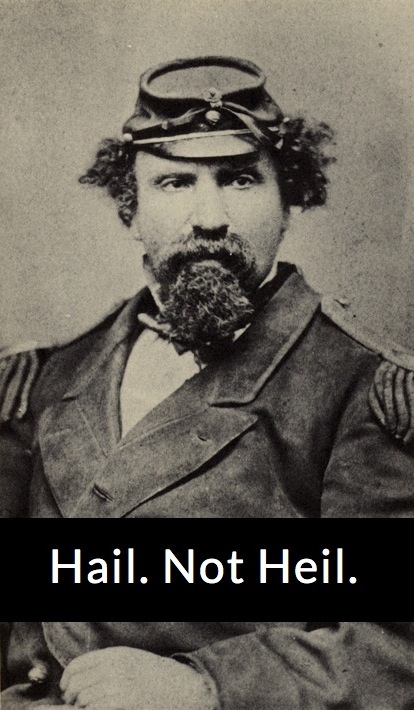
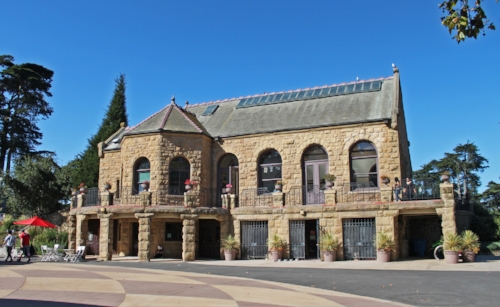
There is a proposal afoot to name the Sharon Meadow, in San Francisco's Golden Gate Park, for the late comedian and actor Robin Williams. The rationale being used strengthens the case for naming the San Francisco-Oakland Bay Bridge for Emperor Norton.
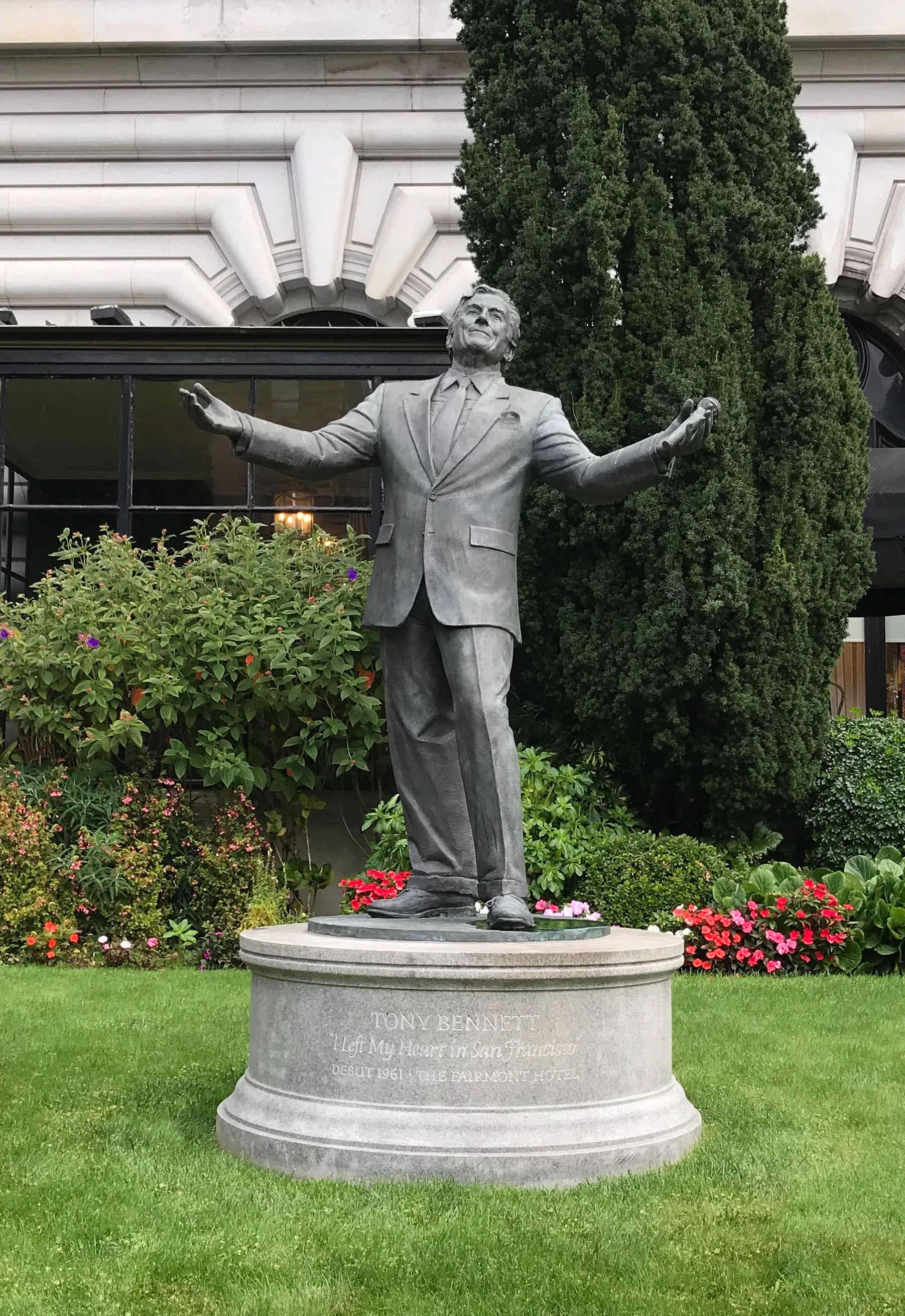
Today, in celebration of his 90th birthday, Tony Bennett was on hand in San Francisco to receive a well-deserved tribute: the unveiling of a larger-than-life statue of him in front of the Fairmont Hotel, where he made his San Francisco debut in 1954 — and where he introduced his immortal signature song, "I Left My Heart in San Francisco," in 1961.
Bennett was given the tribute because — although he wasn't born in San Francisco, and although he never lived here — he was a true San Franciscan.
Emperor Norton is another gentleman who — like Tony Bennett — became a true San Franciscan by loving the city and being loved in return.
It is long past time for Emperor Norton to be honored with a tribute that rises to the level. A tribute that recognizes the Emperor for setting out the original vision for the San Francisco-Oakland Bay Bridge and for being one of the earliest champions of the values of openness, tolerance, fair play and the common good that came to be identified with San Francisco, Oakland and the Bay Area — and that celebrates him for doing all of this with the whimsical and irrepressible style that is the hallmark of his adopted city.
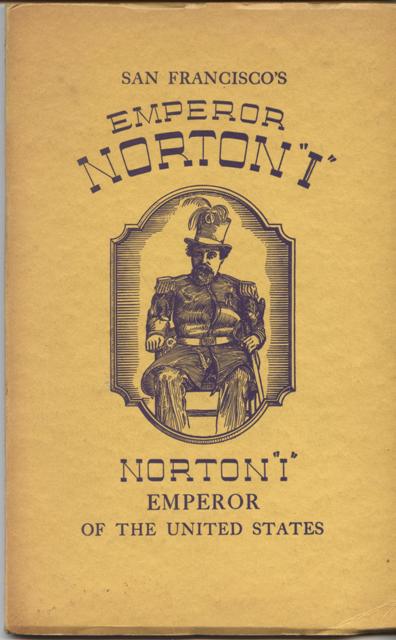
No proclamation attributed to Emperor Norton more often is actually quoted than the one in which he is said to have railed against the word "Frisco." But did the Emperor actually write this? As it turns out, the source of the "Frisco" proclamation is far from clear. In this wide-ranging, link-packed essay, we detail our quest for the origins of the decree and find that all roads may lead to 1939.

The Emperor outlines his immigration policy in this timely Proclamation, published in the Pacific Appeal newspaper on 24 April 1875.
A portion of remarks offered by Emperor's Bridge Campaign founder and president John Lumea at the Campaign's inaugural celebration of Empire Day in San Francisco's Redwood Park on 17 September 2015. The event was held to mark the 156th anniversary of Joshua Norton's declaration of himself as "Emperor of these United States" on 17 September 1859 and to welcome the 157th year of the Nortonian realm and reign.

An Empire Day meditation on one of least understood words of Emperor Norton's original Proclamation of 17 September 1859.
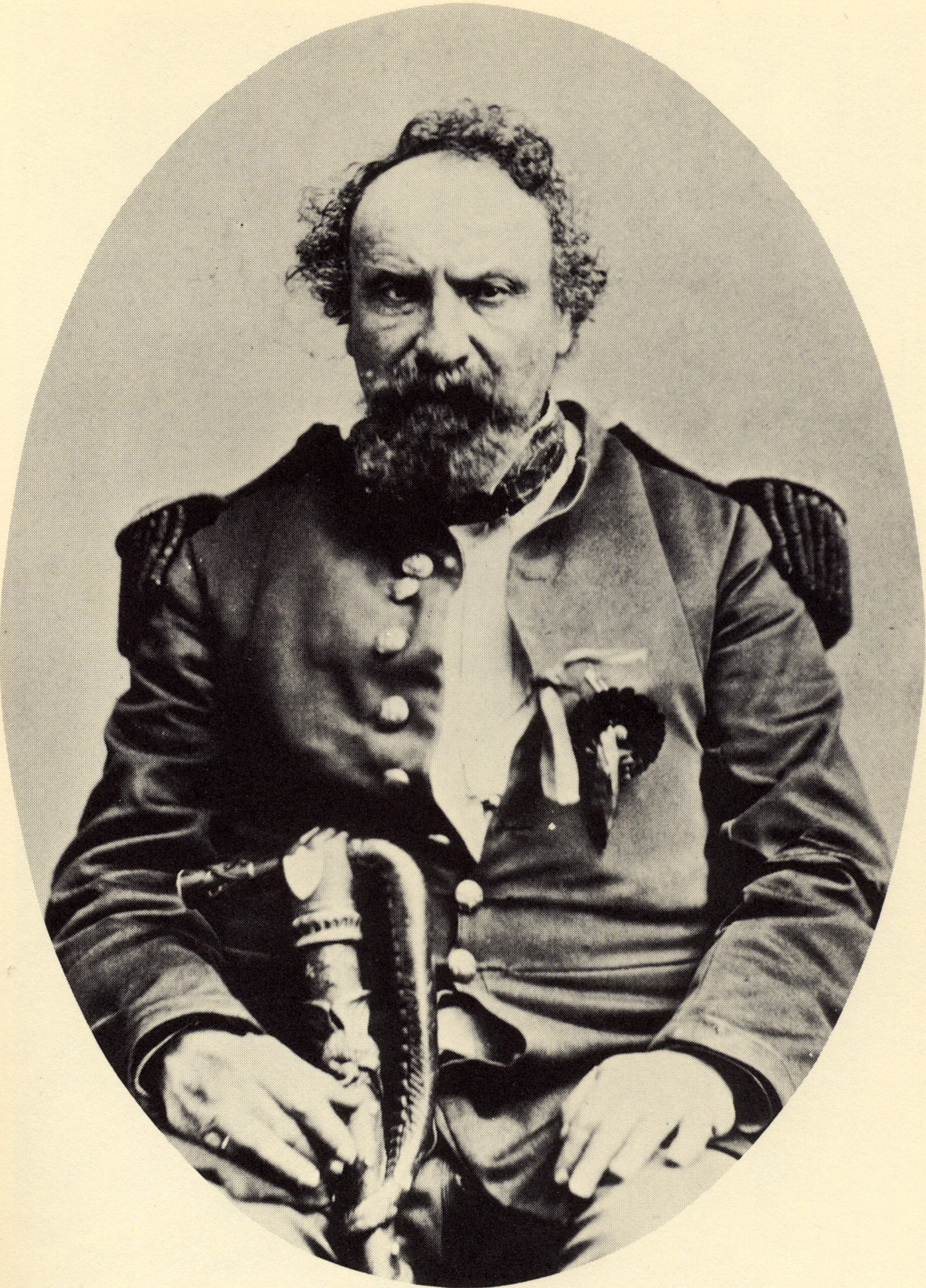
In the current San Francisco mayoral election, one of the challengers to sitting mayor Ed Lee has offered an anti-corruption plan that includes a proposal that San Francisco create a new elected office for a Public Advocate.
Other major cities already have Public Advocates; the level of authority depends on the city.
But the general idea is that the Public Advocate is a kind of official watchdog — someone who helps to ensure that the citizens are being treated fairly; that government agencies and private companies are properly maintaining basic utilities and services like streets, public transit, water, electricity and gas (and not gouging the people in the process); and that corruption that affects the general populace is called out wherever it is found.
Sound familiar? It should.
The original Public Advocate is Emperor Norton.

The story of those who stood by Emperor Norton at his death in 1880 — and two prominent organizations that did not, when the Emperor was reburied in 1934. Includes images of original archival documents published for the first time.

It long has been known that, upon Emperor Norton's death in January 1880, many of his personal effects — including his regimentals, a hat, his sword and his treasured Serpent Scepter, an elaborate walking stick given him by his subjects in Oregon — went to the Society of California Pioneers (only to be lost 26 years later in the earthquake and fire).
Many, but not all. This week, we discovered archival traces of an early 1880 donation to the Odd Fellows' Library Association of San Francisco. The donation — by David Hutchinson, Emperor Norton's longtime landlord at the Eureka Lodgings — included the stamp the Emperor used to place his seal on his proclamations. It might also have included the Emperor's final proclamation: written and sealed, but not yet delivered and published.

You're not likely to encounter a more thoughtful or potent meditation on Emperor Norton and what he means than this.

How two of the Emperor's most loyal subjects sought to celebrate him but — despite their best intentions — wound up leading a generation to get one of the most basic facts about him wrong.
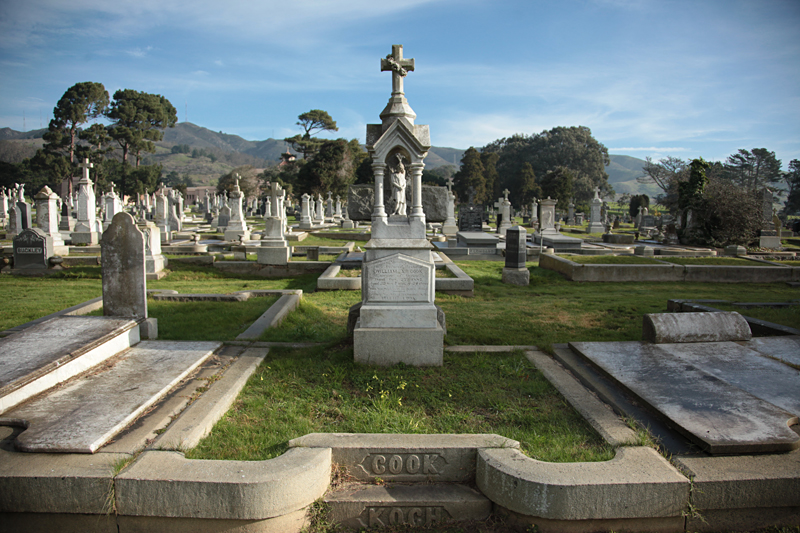
In 1934, Emperor Norton was (re)buried in Colma, Calif. But the connection of Colma to the life of San Francisco runs much, much deeper than simply providing real estate for burial plots. SF Weekly reporter Joe Eskenazi was up this past week with a really fine historical-observational piece that fleshes out everything that Colma has done for San Francisco, and why this matters.

Might an elder statesman of San Francisco and California state politics take one more run at Sacramento and use the opportunity to make a bold and elegant gesture?
Hmmmm . . .

According to Google Trends, an identifiable surge in Bay Area interest in Emperor Norton began in late 2011. The surge continues today.